JOURNAL / LONGEVITY
Rapamycin Showed No Survival Advantage in 11,474 Transplant Recipients
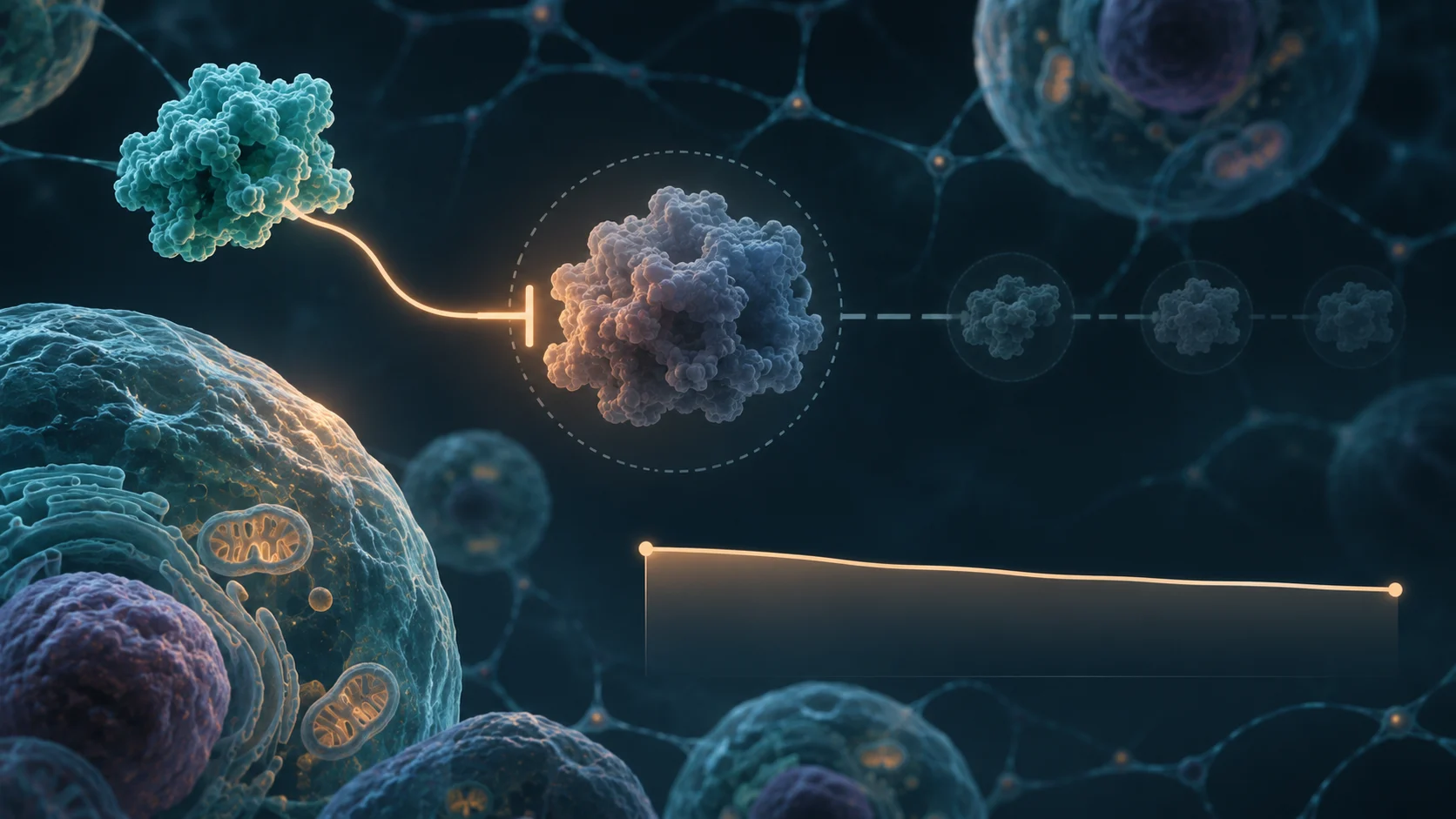
Rapamycin has one of the strongest reputations in experimental longevity.
It extends lifespan in mice. It inhibits mTOR, a nutrient-sensing pathway involved in growth, metabolism and aging biology. A large randomized trial is underway to test whether it can extend lifespan in companion dogs.
But the question that matters is still unanswered: Does rapamycin help humans live longer?
A new study in GeroScience examined one of the largest human populations with long-term exposure to an mTOR inhibitor. Researchers compared 11,474 kidney transplant recipients and followed them for a median of approximately 11 years.
After accounting for measured differences between the groups, the estimated median survival age was:
- 64.6 years with an mTOR inhibitor
- 64.3 years without one
The difference was statistically compatible with anything from a 1.6-year disadvantage to a 2.0-year advantage. In other words, the study found no meaningful survival signal.
That is not proof that low-dose, intermittent rapamycin cannot benefit healthy adults. This was an observational analysis of medically complex transplant recipients using immunosuppressive regimens that differ substantially from off-label longevity protocols.
But it is an important human result—and a reminder that impressive animal data do not automatically become longer human lives.
What the researchers studied
Darren E. Stewart and William E. Fitzsimmons analyzed data from the US Organ Procurement and Transplantation Network, or OPTN.
The researchers included adults who:
- Received a solitary kidney transplant between 2000 and 2007
- Were alive with a functioning transplanted kidney at the one-year follow-up
- Were prescribed tacrolimus or cyclosporine, both calcineurin inhibitors
- Were not prescribed mycophenolate
- Had consistent mTOR-inhibitor status at discharge and at the one-year follow-up
The exposure group contained 4,885 recipients prescribed an mTOR inhibitor at both time points. The comparison group contained 6,589 recipients who were not prescribed one at either point.
The mTOR-inhibitor definition included Rapamune, generic sirolimus and Zortress. Sirolimus is the drug commonly called rapamycin; Zortress is another drug in the same mTOR-inhibitor class.
Median follow-up was approximately 11.5 years. Across the full study period, 6,443 participants died. The primary analysis censored people when their kidney graft failed, resulting in 4,722 deaths observed before graft failure; the researchers also performed an analysis that continued following patients after graft failure.
This was not a randomized trial. Physicians had decided which patients received each immunosuppressive regimen. That creates an immediate problem: people prescribed an mTOR inhibitor may differ from those who are not.
The investigators therefore used propensity-score weighting to balance the groups across 18 measured characteristics, including age, body mass index, diabetes, kidney function, donor type, transplant year, other immunosuppressive drugs and complications during the first post-transplant year.
Before adjustment, the mTOR-inhibitor group was almost four years younger and differed in several other important ways. After weighting, the measured characteristics were closely aligned.
What the data actually showed
The clearest result came from the adjusted analysis that continued following participants after graft failure.
Median survival age was:
- 64.6 years in the mTOR-inhibitor group
- 64.3 years in the comparison group
- Adjusted difference: 0.3 years
- 95% confidence interval: −1.6 to 2.0 years
That confidence interval crosses zero and includes the possibility of either modest harm or modest benefit. The study therefore cannot establish that the treatments were exactly equivalent. It shows that the dataset did not contain a statistically reliable survival advantage.
The primary analysis, which censored participants at graft failure, reached the same basic conclusion. After weighting, estimated median survival was 66.1 years with an mTOR inhibitor and 66.7 years without one. The difference was not statistically significant.
The result also held when the researchers:
- Analyzed tacrolimus and cyclosporine recipients separately
- Included people taking mycophenolate
- Defined exposure using only the one-year medication record
- Measured survival as time after the first post-transplant year rather than age at death
The adjusted survival curves were highly similar. Recorded causes of death were also generally comparable, although the registry’s cause-of-death reporting was incomplete.
The authors’ conclusion was direct: they did not observe a meaningful improvement in long-term survival with mTOR inhibition.
Why this matters for the longevity argument
Rapamycin is not an arbitrary anti-aging candidate.
In mice, it has extended both average and maximum lifespan, including when treatment began in midlife. Those findings helped make mTOR inhibition one of the most closely watched strategies in geroscience.
The transplant registry offers something that most longevity research cannot yet provide: thousands of humans with years of exposure and long-term mortality follow-up.
It also provides a useful tension in the evidence.
The early mouse longevity experiments did not rely exclusively on tiny or occasional exposures. The authors note that some mouse studies used continuous daily administration at doses that equaled or exceeded doses used in mouse transplant models. Daily immunosuppressive exposure can extend lifespan in mice.
In this human transplant population, however, long-term exposure produced no visible survival advantage after adjustment.
That does not overturn the mouse research. It shows that the translation from animal lifespan to human lifespan remains unproven.
It also matters because the public conversation around rapamycin can move faster than the evidence. A plausible mechanism is not the same as a demonstrated clinical outcome. Neither is a mouse-lifespan result, a changed biomarker or an anecdotal report from someone taking the drug off label.
For a longevity intervention, the claim eventually has to survive contact with human outcomes.
This dataset did not provide that signal.
What this does not mean
This study does not prove that rapamycin is useless for healthy adults.
The participants were kidney transplant recipients who had experienced end-stage kidney disease. They were taking multiple immunosuppressive medications, and the mTOR inhibitors were generally used regularly to help prevent organ rejection.
That context is fundamentally different from the low-dose, intermittent schedules sometimes used off label in longevity settings.
The study was also observational. Propensity weighting can balance the characteristics recorded in the registry, but it cannot eliminate every difference between people who did and did not receive the drug.
The authors specifically identified potential unmeasured differences involving malignancy history, infection risk, proteinuria, wound complications and clinician or transplant-center practices.
Exposure measurement was another limitation. The registry established treatment status at discharge and one year, but it did not continuously record medication use throughout the entire follow-up period.
Among available visits during years two through five, the mTOR inhibitor was still prescribed at 75% of visits in the original exposure group and 3% in the comparison group. That supports meaningful separation between the groups, but it does not prove uninterrupted long-term use or capture exact doses and adherence.
The study therefore cannot answer whether a particular intermittent protocol improves healthspan or lifespan in otherwise healthy adults.
It can answer a narrower question: Did a large group of transplant recipients prescribed an mTOR inhibitor show a long-term survival advantage over a carefully adjusted comparison group?
They did not.
The tradeoff cannot be separated from the claim
Rapamycin is a prescription immunosuppressant, not a neutral supplement.
Potential concerns relevant to clinical monitoring include mouth ulcers, changes in lipids or glucose, infections and impaired wound healing. The transplant registry analysis was designed to study survival, not to quantify these effects in people using intermittent longevity protocols.
That distinction matters.
When a drug has meaningful biological effects and meaningful potential downsides, the standard should not be simply whether it changes a pathway associated with aging. The question is whether the expected human benefit is large and reliable enough to justify the burden and risk.
At present, this study does not supply evidence of longer human survival.
What to ask a clinician
For someone already using rapamycin—or considering a conversation about it—the most useful questions are not about finding a supposedly optimal longevity schedule. They are about the uncertainty surrounding the entire strategy.
Consider asking:
-
What specific outcome are we trying to improve? Is the goal based on a symptom, a diagnosed condition, a measurable risk or an unproven longevity hypothesis?
-
What human evidence supports that outcome? Mouse lifespan extension is important research, but it is not proof of longer human life.
-
How will benefit be evaluated? A laboratory change should not automatically be treated as proof that aging has slowed.
-
How will potential harms be monitored? Ask how the clinician plans to watch for mouth ulcers, lipid or glucose changes, infection concerns and problems with wound healing.
-
What happens around illness, surgery or a wound? An immunomodulating drug deserves a clear plan for situations in which infection control and healing matter.
-
What result would make us reconsider? A responsible experiment should include stopping rules and a definition of what would count as insufficient benefit.
These questions do not turn an uncertain longevity intervention into a proven one. They make the uncertainty harder to ignore.
The practical takeaway
Rapamycin remains scientifically interesting. The animal evidence is stronger than it is for most proposed longevity drugs, and prospective research in dogs and humans may clarify whether a different population or regimen produces a different result.
But the new human evidence is not a longevity win.
Among 11,474 kidney transplant recipients followed for roughly 11 years, adjusted median survival was nearly identical with and without mTOR inhibition. The population, dosing context and observational design prevent that finding from settling the question for healthy adults.
They do not make the null result irrelevant.
For now, rapamycin’s ability to extend human life remains a hypothesis—not an established benefit.
Source
Stewart DE, Fitzsimmons WE. Rapamycin and human longevity among kidney transplant recipients surviving the first year. GeroScience. Published November 5, 2026. Open access. Full article: https://link.springer.com/article/10.1007/s11357-026-02643-8. DOI: 10.1007/s11357-026-02643-8.
This article is not a diagnosis, prescription or substitute for care from a qualified clinician who knows your history.