JOURNAL / HEART HEALTH & PREVENTION / TMB-2026-08-03-PCSK9
The First Oral PCSK9 Inhibitor Is Here: What a 56% LDL Reduction Does—and Does Not—Prove
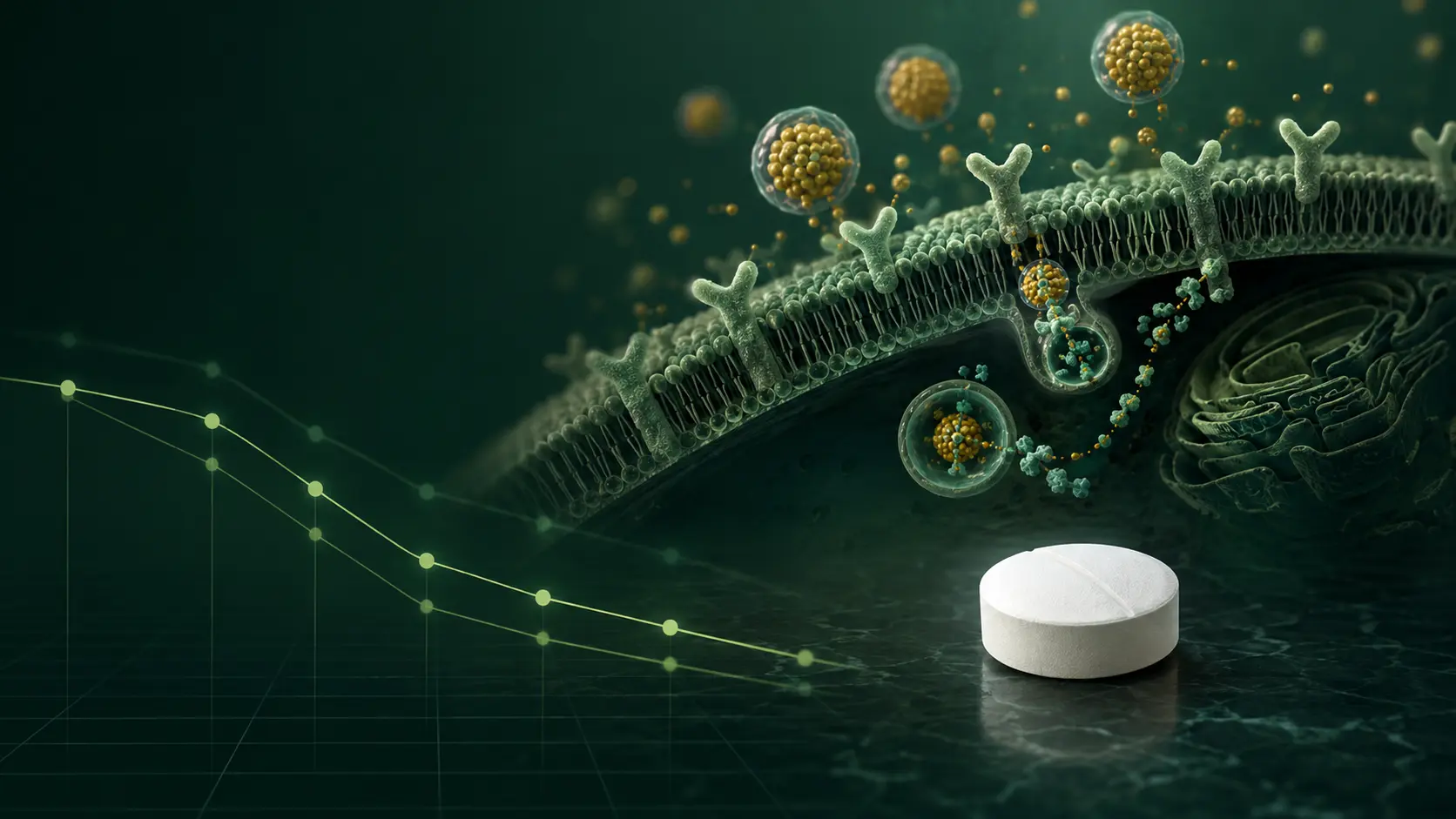
Biohacking culture tends to direct its attention toward what is experimental: new peptides, biological-age tests, mitochondrial compounds and therapies that promise to slow aging.
But one of the most consequential healthspan developments of 2026 concerns something far less exotic.
Cholesterol.
On July 17, 2026, the FDA announced the approval of Lipfendra, the brand name for enlicitide, as the first oral PCSK9 inhibitor. It is approved as an adjunct to diet and exercise for reducing LDL cholesterol in adults with hypercholesterolemia, including heterozygous familial hypercholesterolemia. FDA approval announcement
PCSK9 inhibitors have been available for years, but previously approved options required injections. Enlicitide brings a similar biological mechanism into a once-daily tablet.
In phase 3 trials, it produced placebo-adjusted LDL-C reductions of approximately 56% in adults with established or elevated cardiovascular risk and 59% in adults with inherited high cholesterol. It also substantially lowered apolipoprotein B, or ApoB.
Those are impressive results.
They do not, however, prove that enlicitide prevents heart attacks, extends life or belongs in every health-optimization protocol.
The evidence supports excitement—but disciplined excitement.
Why PCSK9 matters
The liver removes LDL particles from circulation using LDL receptors on the surface of liver cells.
PCSK9 is a protein that binds to those receptors and promotes their breakdown. When more receptors are destroyed, the liver has less capacity to clear LDL from the blood.
Blocking PCSK9 protects those receptors. More receptors remain available, and circulating LDL falls.
This mechanism is already clinically validated. Injectable PCSK9-targeting antibodies such as evolocumab and alirocumab have lowered LDL by roughly 60% and reduced cardiovascular events in large randomized trials involving high-risk patients.
In the FOURIER trial, evolocumab reduced the primary composite cardiovascular endpoint from 11.3% to 9.8% over a median 2.2 years. In ODYSSEY OUTCOMES, alirocumab reduced recurrent ischemic events following acute coronary syndrome.
Enlicitide targets the same protein differently. It is a macrocyclic peptide small enough—and specially formulated—to be taken orally.
That is the genuine innovation: not discovering PCSK9, but making potent PCSK9 inhibition available without an injection.
What the pivotal trial found
The main CORALreef Lipids trial enrolled 2,904 adults across 168 sites in 14 countries.
Participants either had a previous major atherosclerotic cardiovascular event and an LDL-C level of at least 55 mg/dL, or were at risk of a first event and had LDL-C of at least 70 mg/dL. Nearly all were already taking statins.
Participants were randomly assigned to daily enlicitide or placebo for 52 weeks.
At week 24:
| Marker | Placebo-adjusted change with enlicitide |
|---|---|
| LDL-C | −55.8% |
| Non-HDL cholesterol | −53.4% |
| ApoB | −50.3% |
| Lipoprotein(a) | −28.2% |
Approximately 70% of enlicitide recipients reached both an LDL-C below 70 mg/dL and at least a 50% reduction from baseline. Roughly 68% reached an LDL-C below 55 mg/dL with at least a 50% reduction.
The overall frequency of adverse events was similar between the enlicitide and placebo groups during the trial. Serious adverse events, discontinuations and new or worsening diabetes were also similar.
The effect remained substantial at 52 weeks, although the between-group LDL difference was smaller than at week 24. CORALreef Lipids phase 3 trial
These findings establish that enlicitide can dramatically alter atherogenic lipid measurements when added to background therapy.
They do not yet establish its effect on cardiovascular events.
The inherited-cholesterol trial
A second phase 3 trial studied 303 adults with heterozygous familial hypercholesterolemia, or HeFH.
People with HeFH experience elevated LDL from an early age, creating a much higher cumulative lifetime exposure to atherogenic particles. Many remain above treatment targets despite statins and other medications.
At week 24, the placebo-adjusted LDL reduction with enlicitide was 59.4%. ApoB, non-HDL cholesterol and Lp(a) also fell significantly.
Treatment adherence was approximately 97%, while more than 96% of participants reported following the fasting instructions all or most of the time.
The safety profile was broadly similar between groups, although diarrhea occurred in 7% of enlicitide recipients versus 2% with placebo, and dizziness occurred in 9% versus 4%.
The trial was relatively small and lasted one year. It was designed to evaluate lipid changes and common adverse effects—not rare complications or long-term cardiovascular outcomes. CORALreef HeFH phase 3 trial
Why ApoB may be the more important number
LDL-C measures the amount of cholesterol carried inside LDL particles. ApoB provides an estimate of the number of atherogenic particles, because each major LDL, VLDL, IDL and Lp(a) particle carries one ApoB molecule.
The two measurements often move together, but they can become discordant.
Someone with insulin resistance or elevated triglycerides, for example, may have many cholesterol-depleted atherogenic particles. Their LDL-C can appear acceptable while ApoB remains elevated.
The 2026 ACC/AHA dyslipidemia guideline continues to use LDL-C and non-HDL-C as central treatment targets, while recommending selective ApoB measurement to identify residual risk—particularly in people with diabetes, cardiovascular-kidney-metabolic disease, high triglycerides or established cardiovascular disease. 2026 ACC/AHA dyslipidemia guideline
That makes enlicitide’s approximately 50% ApoB reduction meaningful.
It suggests the drug did not merely change how cholesterol was distributed. It substantially reduced the number of circulating atherogenic particles.
But a better biomarker is still a biomarker. The ultimate objective is preventing disease, disability and premature death.
The Lp(a) finding deserves restraint
Enlicitide also lowered Lp(a) by approximately 25% to 28% in the phase 3 studies.
Lp(a) is a genetically influenced atherogenic particle associated with heart attack, stroke and aortic-valve disease. The new dyslipidemia guideline recommends that adults have it measured at least once.
An Lp(a) level of at least 125 nmol/L—or approximately 50 mg/dL—is considered a risk-enhancing factor. Lifestyle changes usually have little effect on it. ACC guideline summary
Enlicitide’s Lp(a) reduction is therefore interesting, but several cautions apply:
- Enlicitide is not approved specifically as an Lp(a)-lowering therapy.
- The Lp(a) change was a secondary laboratory endpoint.
- The trials did not establish that this reduction prevents Lp(a)-related cardiovascular events.
- Dedicated Lp(a)-targeting therapies may eventually produce much larger reductions, although outcome studies are still required.
People with elevated Lp(a) should not interpret the new approval as proof that enlicitide neutralizes their inherited risk.
It may become one component of more intensive risk reduction, but the evidence must be evaluated in context.
LDL lowering is established—but the exact drug still needs an outcomes trial
There is strong evidence that sustained LDL lowering reduces cardiovascular risk. This conclusion is supported by genetics and by randomized trials involving statins, ezetimibe and injectable PCSK9 inhibitors.
That makes enlicitide’s results biologically and clinically plausible.
Still, class-wide evidence cannot answer every product-specific question.
Enlicitide’s approval was based on its ability to lower LDL-C, not on demonstrated reductions in heart attacks, strokes or cardiovascular deaths. A letter published in the New England Journal of Medicine highlighted this limitation, along with the 52-week duration of the main efficacy study.
A dedicated outcomes trial is underway.
CORALreef Outcomes has enrolled an estimated 14,550 high-risk participants and is comparing enlicitide with placebo for major cardiovascular events. Its primary completion is estimated for late 2029, with further follow-up extending beyond that date.
Until those results arrive, the most accurate conclusions are:
- Enlicitide powerfully lowers LDL-C and ApoB.
- Existing PCSK9 biology and injectable-drug trials make cardiovascular benefit plausible.
- Cardiovascular benefit from enlicitide itself has not yet been demonstrated.
- Rare adverse effects and multi-year safety cannot be established from the current trials.
The difference between “likely based on strong indirect evidence” and “directly proven” matters.
A pill is not automatically easier than an injection
Oral delivery removes needles, refrigeration considerations and injection-site reactions. It may also make potent LDL lowering easier to introduce in primary-care settings.
But convenience is personal.
Enlicitide must be taken every morning on an empty stomach with water, black coffee or plain tea. The tablet must be swallowed whole, and patients must wait at least 30 minutes before consuming food or other beverages. Official prescribing information
That routine may fit someone who already takes morning medication. It may be harder for someone who eats immediately after waking, uses a protein shake, adds cream to coffee or struggles with daily adherence.
Injectable PCSK9 therapies require a shot every two to four weeks. Some people strongly prefer avoiding injections; others may find an infrequent injection easier than remembering a carefully timed pill every day.
The practical comparison is therefore not simply “pill good, injection bad.”
It is:
- Daily oral adherence with a fasting window
- Versus less-frequent injectable adherence
- Alongside differences in coverage, cost, tolerability and clinical evidence
The best format is the one a qualified patient can use correctly and consistently.
Where enlicitide may fit
The new drug is most relevant to adults who need substantial additional LDL reduction, such as:
- People with established atherosclerotic cardiovascular disease who remain above their individualized LDL goal
- Adults with HeFH
- High-risk patients who remain above goal despite a maximally tolerated statin
- People who cannot achieve sufficient reduction with statin plus ezetimibe or another oral option
- Appropriate patients who decline or cannot reliably use injectable therapy
The 2026 guideline describes statins as the foundation of lipid-lowering drug therapy because their cardiovascular benefits, long-term safety and affordability are well established.
Enlicitide should not automatically be framed as a statin replacement.
The pivotal trials primarily evaluated it as an addition to background statin therapy. Whether it should replace another medication depends on an individual’s risk, prior response, side effects, treatment goals and insurance access.
Where biohackers can go wrong
The arrival of a powerful oral therapy creates several predictable opportunities for overreach.
Treating one number in isolation
LDL-C is important, but treatment decisions should account for overall cardiovascular risk, blood pressure, smoking, diabetes, kidney health, family history, ApoB, Lp(a) and evidence of existing plaque.
Assuming lower is always personally necessary
Very low LDL levels have been studied in high-risk populations, but that does not mean every low-risk young adult needs prescription therapy to drive LDL as low as possible.
Potential absolute benefit depends heavily on baseline risk.
Skipping first-line interventions
A new drug does not replace exercise, sleep, dietary quality, blood-pressure control, smoking cessation or management of diabetes and excess weight.
It also does not erase the extensive outcome evidence supporting statins.
Confusing biomarker improvement with longevity
Reducing lifelong exposure to atherogenic particles is an evidence-based prevention strategy. But no trial has shown that enlicitide extends life in healthy longevity enthusiasts.
Calling it a “longevity pill” would go beyond the evidence.
Ignoring adherence requirements
A medication cannot reproduce its trial effect when it is taken irregularly or with conditions that substantially reduce absorption.
A smarter cardiovascular-testing pathway
For evidence-minded adults, the practical lesson is not “ask for enlicitide.”
It is to build a better assessment of risk.
1. Start with a standard fasting or nonfasting lipid panel
Review LDL-C, HDL-C, triglycerides and non-HDL cholesterol. One abnormal result should be interpreted alongside previous values and the clinical context.
2. Consider ApoB when it could change the decision
ApoB can be especially useful when triglycerides are high, insulin resistance is present, LDL-C appears discordant with other risk markers or cardiovascular disease is already established.
3. Measure Lp(a) at least once
Because Lp(a) is largely genetically determined, one adult measurement is generally enough to identify inherited elevation.
4. Estimate short- and long-term risk
The 2026 guideline uses the PREVENT-ASCVD equations for many adults without known cardiovascular disease. Ten-year risk should not be the only consideration; lifetime exposure matters, especially with inherited or markedly elevated LDL.
5. Use coronary calcium selectively
For men aged at least 40 and women aged at least 45 with borderline or intermediate risk, a coronary-artery-calcium scan can sometimes clarify whether medication should begin or intensify.
CAC is not appropriate for every person, and a zero score does not erase all risk—particularly in younger adults, smokers, people with diabetes or those with strong inherited risk.
6. Choose therapy based on the size of the gap
The question is not which drug is newest. It is how much additional reduction is needed to reach an evidence-based target.
A small gap may be closed with lifestyle changes, a statin adjustment or ezetimibe. A much larger gap may justify more potent combination therapy.
Who should be especially cautious?
Additional caution and clinician review are important for:
- People who are pregnant, planning pregnancy or breastfeeding
- Children and adolescents, because adult approval does not establish pediatric safety
- People with unexplained dizziness, chronic diarrhea or difficulty maintaining hydration
- Anyone already using multiple lipid-lowering medications
- People with liver, kidney, endocrine or metabolic conditions affecting lipid interpretation
- Adults considering treatment based on a single test without an overall risk assessment
- Anyone planning to stop a statin or another prescribed medication after hearing about the new option
The prescribing information advises discontinuing enlicitide when pregnancy is recognized unless the benefits of treatment outweigh potential fetal risks. It also notes that human pregnancy and lactation data are insufficient, and that pediatric safety and effectiveness have not been established.
Seven questions to discuss with a clinician
Before adding any powerful lipid-lowering medication, ask:
- What is my estimated 10-year and 30-year cardiovascular risk?
- Do I have established plaque, familial hypercholesterolemia or another high-risk condition?
- What LDL-C, non-HDL-C or ApoB goal applies to me?
- How much additional reduction do I actually need?
- Have I used an adequately intensive and tolerated statin regimen?
- Would ezetimibe, bempedoic acid, an injectable PCSK9 therapy or enlicitide best fit the size of the treatment gap?
- When should laboratory testing be repeated to confirm response and adherence?
These questions turn a product-focused conversation into a risk-focused one.
The broader innovation: oral peptide delivery
There is another reason enlicitide deserves attention from the biohacking and longevity communities.
It is itself a macrocyclic peptide.
Peptides are generally difficult to deliver orally because digestive enzymes break them down and the intestinal wall limits absorption. That is why insulin and many other peptide medicines require injections.
Enlicitide demonstrates that carefully engineered peptide structure and formulation can sometimes overcome that barrier well enough for a daily tablet.
This does not mean popular injectable “wellness peptides” can now be converted into equivalent oral supplements. Each molecule has different stability, absorption and pharmacology.
It does suggest that oral delivery could become an increasingly important direction for legitimate peptide-drug development.
That may ultimately be as important as this particular cholesterol medication.
The bottom line
Enlicitide is a meaningful cardiovascular-prevention advance.
It brings powerful PCSK9 inhibition into an oral tablet and produced placebo-adjusted LDL reductions of approximately 56% to 59% in randomized phase 3 trials. ApoB and non-HDL cholesterol also fell substantially, while common adverse-event rates were broadly similar to placebo.
The limitations are equally important.
The pivotal trials measured lipids—not heart attacks, strokes or longevity. Long-term safety remains less established than it is for older therapies. The medication has a specific fasting routine, and its absolute benefit will depend on the patient’s underlying cardiovascular risk.
For evidence-minded biohackers, the lesson is bigger than any single drug:
- Measure risk before optimizing a number.
- Consider cumulative exposure, not only today’s LDL.
- Use ApoB and Lp(a) when they add meaningful information.
- Preserve lifestyle and established first-line therapy.
- Distinguish biomarker efficacy from proven health outcomes.
- Watch the CORALreef Outcomes trial before making claims about event prevention.
The first oral PCSK9 inhibitor could make intensive LDL lowering available to more people.
Whether it also becomes a major longevity tool will be determined by outcomes—not enthusiasm.
Educational disclaimer: This article is for general educational purposes only and is not medical advice, diagnosis or treatment guidance. Prescription lipid-lowering therapy requires individualized cardiovascular-risk assessment and monitoring by an appropriately licensed healthcare professional. Do not start, stop or replace prescribed medication based on this article.
This article is not a diagnosis, prescription or substitute for care from a qualified clinician who knows your history.