JOURNAL / TESTING & LONGEVITY / TMB-2026-08-10-AGING-CLOCKS
Your Biological Age Is Not One Number: What Aging Clocks Can—and Cannot—Tell You
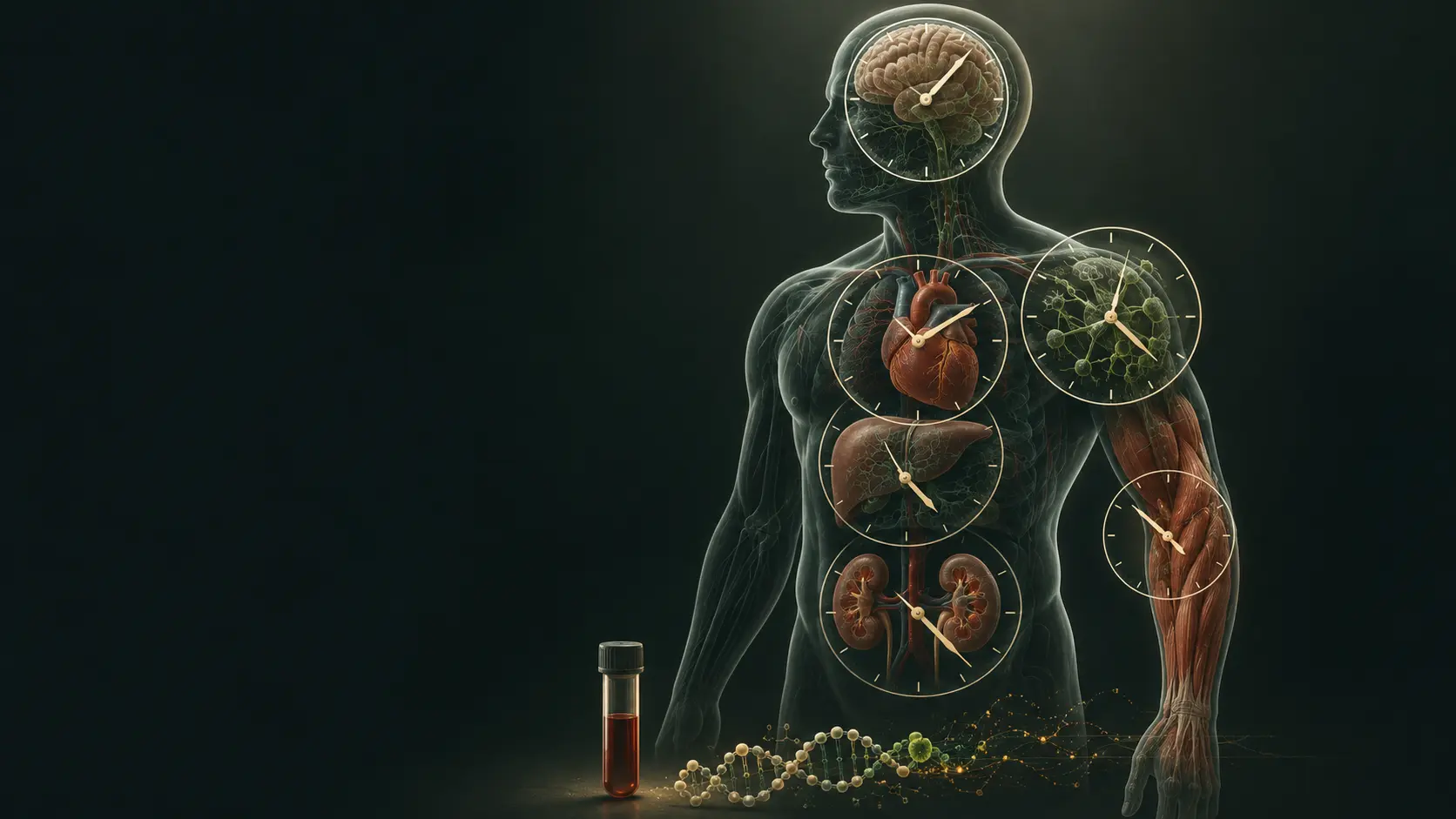
A biological-age test can produce an irresistible result: you are 47 years old, but your body is supposedly 39.
That single number feels precise. It can become a scorecard for a supplement stack, a training plan, a fasting routine or an entire longevity program.
The science is more interesting—and much less tidy.
Biological-aging clocks are algorithms trained to recognize patterns associated with aging in data such as DNA methylation, blood proteins, routine laboratory markers, medical images or physical function. At a population level, several clocks are associated with disease, disability and mortality. Some are beginning to reveal that the brain, immune system, liver and other organs can age at different rates within the same person.
But no universally accepted test can compress every dimension of human aging into one clinically definitive age. Different clocks were built for different purposes, and two valid clocks can disagree without either being fraudulent.
A major 2026 review in Nature Medicine describes biological clocks as promising tools for risk stratification, prevention research and the study of interventions—while emphasizing the substantial work still required before they can guide routine individual care. Biological aging clocks in health and disease
The right question is therefore not, “What is my true biological age?”
It is, “What exactly did this test measure, how reliable is that measurement, and would the result change anything useful?”
Chronological age and biological age are different ideas
Chronological age is the time since birth. It is easy to measure and remains one of the strongest predictors of many health outcomes.
Biological age is an attempt to describe how much age-related change a person has accumulated—or how quickly that change is occurring—relative to others.
That concept is plausible because people of the same chronological age can differ greatly in cardiometabolic health, immune function, cognition, physical capacity and disease risk. Yet “biological age” is not a single substance circulating in the blood. It is a model-derived summary of selected measurements.
Every clock reflects choices:
- Which biological data were included
- Which population supplied the training data
- Which outcome the model was designed to predict
- How samples were collected and processed
- Whether the output estimates age, risk or pace of change
A clock trained to predict chronological age is not automatically the best clock for predicting mortality. A mortality-oriented clock is not automatically a direct measure of cellular damage. A test of blood does not necessarily describe every organ.
The major families of aging clocks
DNA-methylation clocks
DNA methylation is a chemical modification that helps regulate gene activity. Methylation patterns at particular sites change predictably with age, allowing algorithms to estimate an epigenetic age from a blood or tissue sample.
Early clocks were optimized to predict chronological age. Later clocks such as PhenoAge and GrimAge incorporated health or mortality-related information. DunedinPACE was designed differently: it estimates the pace of aging from a single blood sample after being trained on two decades of within-person change across 19 organ-system measures. A score of 1 represents roughly one year of biological change per chronological year in the reference framework. DunedinPACE study
These distinctions matter. A result reported in “years” and a pace score reported as a rate are not interchangeable.
Proteomic clocks
Proteomic clocks analyze patterns among proteins circulating in blood. Because many proteins originate preferentially from particular tissues, these tests can be used to model organ-specific aging rather than only whole-body age.
In a 2023 Nature study spanning 5,676 adults across five cohorts, researchers modeled aging in 11 organs. About 20% of participants showed strongly accelerated aging in one organ, while roughly 1.7% showed multi-organ aging. Accelerated organ age was associated with relevant disease and mortality risk. Organ aging signatures
A larger 2025 study of 44,498 UK Biobank participants linked proteomic brain and immune-system aging with healthspan and longevity. An extremely aged brain signature was associated with substantially higher Alzheimer’s disease risk, while youthful brain and immune profiles were associated with longer survival. These were observational associations, not diagnoses or proof of causation. Brain and immune system aging
In 2026, researchers extended the approach by mapping plasma-protein signatures associated with aging across more than 40 cell types in 60,542 participants. The signatures predicted multiple diseases and mortality during follow-up, suggesting that blood can carry informative traces of cellular aging. Cellular aging proteomics
Clinical and functional clocks
Some models use familiar measurements—blood pressure, glucose, albumin, kidney markers, inflammation, lung function, grip strength, walking speed or cognition. They may be less glamorous than an omics test, but they often connect more directly to established clinical risk and modifiable function.
Imaging and digital clocks
Algorithms can estimate age from brain MRI, retinal images, electrocardiograms and other data. Wearables may eventually contribute longitudinal signals involving sleep, activity, heart-rate dynamics and recovery.
These tools can be valuable in research, but an estimated “brain age” or “heart age” remains model-dependent. It is not a stand-alone medical diagnosis.
Why two legitimate tests can disagree
Imagine a 55-year-old who receives these results:
- Epigenetic age: 49
- Pace of aging: 1.05
- Immune-system age: 62
- Brain age: 53
There is no requirement that one result be the truth and the others mistakes. The tests may capture different biological layers, use different reference populations and optimize different outcomes.
The disagreement itself can reflect an important reality: aging is heterogeneous.
An individual can have favorable metabolic markers but an immune profile associated with faster aging. One organ may appear resilient while another carries accumulated damage. A whole-body average can hide that pattern.
This is why a biological-age result should always retain the name of the clock. “My GrimAge changed” is more informative than “my biological age changed.”
Population prediction is not individual certainty
Many clocks are validated by showing that people with older or faster scores experience more disease or earlier death on average.
That is meaningful science. It does not make a score deterministic.
A risk-associated biomarker cannot tell one person exactly how long they will live. Nor can it identify the cause of an abnormal result by itself. An older score may reflect smoking, inflammation, chronic disease, social disadvantage, treatment effects, cell-composition differences or measurement noise.
For the individual user, three questions matter:
- Discrimination: Does the clock distinguish people with different future outcomes?
- Calibration: Does the numerical risk match what actually happens in a similar population?
- Actionability: Does the result lead to a decision that improves health?
Commercial reports often emphasize the first question while providing little information about the second or third.
Reliability is a hidden limitation
Before asking whether a clock predicts aging, ask whether it can reproduce its own result.
DNA-methylation arrays measure hundreds of thousands of sites, and small technical differences in sample processing can propagate through an algorithm. In a reliability study, conventional epigenetic-clock estimates from technical replicates sometimes differed by years; principal-component versions of the clocks substantially improved reproducibility. Reliability study
That has a practical consequence. If a score changes by two years after three months, the change could represent biology, technical variation or both.
Reliability also differs by test. DunedinPACE was deliberately restricted to more reliable methylation sites and showed strong test–retest performance in validation datasets. High reliability is encouraging, but it does not establish that every small change is clinically meaningful.
What intervention trials have actually shown
The most tempting use of a clock is to test whether a lifestyle change or supplement “reversed aging.” Randomized trials have begun to explore that idea, but the results require restraint.
Calorie restriction
In the CALERIE trial, 220 healthy, non-obese adults were randomized to two years of calorie restriction or an unrestricted diet. Participants in the intervention group achieved about 12% average calorie restriction. The intervention slowed DunedinPACE by roughly 2% to 3%, but did not significantly change PhenoAge or GrimAge acceleration. CALERIE analysis
That is not evidence that participants became years younger. It is evidence of a small effect on one pace-of-aging measure, with other clocks showing no significant change.
Omega-3, vitamin D and exercise
The DO-HEALTH trial analyzed DNA-methylation clocks in 777 adults aged 70 and older. Daily omega-3 produced small favorable effects on several clocks, described as equivalent to a few months of biological aging over three years. Vitamin D and exercise did not show consistent independent effects across clocks, although some combinations appeared additive. DO-HEALTH analysis
The result is scientifically interesting. It does not prove that omega-3 extended life, and it does not justify treating a few clock-months as a clinical outcome.
Multivitamins and cocoa extract
In a 2026 COSMOS analysis of 958 older adults, a daily multivitamin produced modest favorable changes in two principal-component epigenetic clocks, while three other clocks did not show significant effects. Cocoa extract showed no significant effect on the tested clocks. COSMOS aging-clock analysis
Again, the clock-specific pattern matters. “A multivitamin reversed biological aging” would be a stronger claim than the data support.
A clock change is not yet a proven health outcome
For a biomarker to serve as a surrogate endpoint, changing the biomarker should reliably predict a change in an outcome people care about—such as disability, dementia, cardiovascular events or survival.
Biological-aging clocks have not yet cleared that bar as a class.
A clock may predict mortality in observational data and respond to an intervention without proving that the intervention improves mortality. The intervention could affect part of the clock’s formula without altering the underlying disease process. Alternatively, a genuinely helpful intervention may not move a particular clock because that clock does not capture the relevant biology.
The FDA’s biomarker-qualification framework is explicitly tied to a defined context of use. Qualification for one purpose would not validate every aging test, every intervention or every consumer interpretation. FDA biomarker qualification program
This is the central limitation of the category:
Association is not validation as a surrogate endpoint.
How to use biological-age testing intelligently
1. Define the decision before ordering the test
Ask what you will do differently based on the result. If the answer is only “feel encouraged” or “buy another supplement,” the test may not be worth the cost.
2. Identify the exact clock
The report should disclose the biological material, assay, algorithm, reference population, units and intended interpretation. A proprietary score with no methodological transparency is difficult to evaluate.
3. Prefer validated outcomes over a perfect-looking age
Blood pressure, ApoB, glucose regulation, cardiorespiratory fitness, strength, sleep, smoking status and vaccination can carry clearer action paths than a composite age score. An attractive biological-age result should never override an established risk factor.
4. Treat small changes cautiously
Look for the test’s technical error, test–retest reliability and threshold for meaningful change. If the company does not provide those figures, do not assume that a one- or two-year improvement is real.
5. Standardize repeated measurements
Use the same laboratory, assay and clock. Keep collection conditions as consistent as practical, and avoid comparing results during acute illness. Changing the platform can create a false trend.
6. Allow enough time
Very short retesting intervals invite noise and overreaction. The appropriate interval depends on the clock and purpose, but repeated monthly optimization is rarely supported by validation evidence.
7. Track conventional outcomes alongside the clock
If a program claims to improve aging, also monitor the relevant health measures: fitness, strength, body composition, blood pressure, lipids, glucose, symptoms, function and clinician-assessed risk.
8. Do not optimize the algorithm
The goal is better health—not a lower score. An intervention that manipulates one measured pathway could improve the report without improving the person.
Questions to ask a testing company
Before purchasing, ask:
- What is the exact name and version of the clock?
- Was it externally validated in people similar to me?
- What outcome was it trained to predict?
- What is its test–retest reliability?
- What change exceeds expected technical variation?
- Can medication, illness or blood-cell composition affect the result?
- Will future samples use the same assay and algorithm?
- If the algorithm changes, will prior results be recalculated?
- Is the test intended for research, wellness education or clinical decision-making?
- Are my sample and genomic or epigenomic data stored, sold or used to train other models?
The final question deserves special attention. Molecular aging tests can generate sensitive health and biological data. Read the privacy policy before submitting a sample.
Who should be especially cautious?
Additional caution is appropriate for:
- People who may become anxious or compulsive about health scores
- Anyone considering stopping prescribed treatment because a clock looks favorable
- People with active cancer, autoimmune disease, infection or other conditions that may alter blood biology
- People taking medications that substantially affect immune or blood-cell profiles
- Anyone considering risky drugs, extreme calorie restriction or unregulated “rejuvenation” therapies to improve a score
- Consumers using results for insurance, employment or other high-stakes decisions
A surprisingly old score is not a diagnosis. It should prompt review of the test’s validity and conventional health factors—not panic.
A surprisingly young score is not immunity from disease. Screening and prevention should continue according to personal risk and professional guidance.
What would make these tests genuinely transformative?
The field needs more than clocks that correlate with age. It needs:
- Standardized collection and laboratory methods
- Transparent and locked algorithms
- External validation across ancestry, sex, geography and health status
- Longitudinal evidence within the same individuals
- Demonstrated thresholds for meaningful change
- Randomized trials linking clock changes to clinical outcomes
- Clear regulatory contexts of use
- Organ- and cell-specific signals that improve prevention beyond existing tools
The 2026 research direction is encouraging. Large proteomic datasets are moving the field from a single whole-body number toward a map of organ and cellular aging. That may eventually identify which system is changing first and where prevention could be targeted.
But richer measurement does not automatically create a treatment recommendation. It creates a better hypothesis to test.
The bottom line
Biological-age tests are not useless, and they are not oracles.
The strongest clocks capture real population-level information about disease risk, mortality and the pace of age-related change. New proteomic approaches can reveal that organs and cell types age differently within the same person. Randomized trials show that some interventions can move selected clocks by small amounts.
The limitations remain decisive:
- Different clocks measure different constructs.
- A blood-derived number cannot summarize every organ.
- Small changes may fall within technical variation.
- A favorable shift has not yet been proven to mean longer healthspan.
- A biological-age score should not replace established risk assessment or medical care.
The most rational use is as one layer of information—named, repeatable and interpreted alongside conventional measures—not as a universal grade for the body.
Your biology may contain many clocks.
The important question is not whether one of them makes you younger on paper. It is whether the measurement helps you make a safer, better decision in the real world.
Educational disclaimer: This article is for general educational purposes only and is not medical advice, diagnosis or treatment guidance. Biological-age and aging-clock tests vary in validation, reliability and intended use. Do not start, stop or replace medical treatment, or undertake a risky intervention, based on a biological-age score. Discuss health concerns and testing decisions with an appropriately licensed healthcare professional.
This article is not a diagnosis, prescription or substitute for care from a qualified clinician who knows your history.